Lean in High-Mix, Low-Volume Manufacturing: What Actually Works
Summarize this article with:
TL;DR
Complexity doesn’t make lean impractical. It makes flow discipline essential. High-mix manufacturers watch lean succeed on assembly lines and conclude it doesn’t translate to hundreds of variants, complex routing through shared resources, and short runs. In many of those attempts, the problem was not lean’s underlying discipline but the way repetitive-flow tools were selected, adapted, and applied.
Three mechanisms work in high-mix environments: flow over local efficiency (measure how work moves through the value stream, not machine utilization), WIP governance (short queues surface problems while they’re manageable), and visual priority alignment (make the priority logic visible where work decisions happen).
Questions This Blog Answers
- Does lean apply to high-mix, low-volume manufacturing?
- Why have past lean attempts failed in high-mix plants?
- Doesn’t a complex environment need more WIP buffer?
- What does “flow over local efficiency” mean on the shop floor?
- What is visual priority alignment?
The most common misconception in lean manufacturing consulting for complex environments is that complexity makes lean impractical. The opposite is closer to the truth: the more complex the environment becomes, the more important flow discipline becomes.
In the previous article in this series, we examined why compliance systems in aerospace and defense do not automatically produce operational excellence. A similar misconception appears in high-mix, low-volume manufacturing environments. Organizations assume that variability – in product mix, routing, process requirements, and customer demand – makes lean inapplicable. They have spent years watching lean succeed in high-volume repetitive environments and concluded that those successes don’t translate to their world.
That conclusion is wrong. But understanding why requires being precise about what lean is fundamentally about – and why it applies to complex environments in ways that many practitioners do not fully appreciate.
The Misconception About Lean
The popular image of lean manufacturing is built around high-volume repetitive production: automobile assembly lines, large-scale consumer goods manufacturing, high-volume electronics production. These are the environments where Toyota’s production system was first developed and demonstrated, and where lean has produced its most visible and well-documented results.
This history has led many manufacturers in high-mix environments to conclude that lean is not for them. They point to the differences in their operating reality: dozens or hundreds of product variants, complex and variable routing, shared resources competing across product families, frequent engineering changes, short production runs that change weekly or daily. These factors are real. The conclusion drawn from them is not.
Lean is not fundamentally about standardization for the sake of uniformity. It is not primarily about eliminating variety. It is about making flow visible and controllable – regardless of how many product variants the system must handle. The tools and mechanisms differ between high-volume and high-mix environments. The underlying objective does not.
The challenge in high-mix environments is not that lean cannot work. It is that the naive application of lean tools designed for high-volume environments produces disappointing results – which then gets misinterpreted as evidence that lean doesn’t apply to complex manufacturing. In many of those attempts, what failed was not lean’s underlying discipline but the way repetitive-flow tools were selected and applied.
The Reality of High-Mix, Low-Volume Manufacturing
To understand what effective lean looks like in high-mix environments, it is useful to understand what makes those environments operationally difficult.
Product variation means production runs are far less repetitive. Setups differ. Material requirements differ. Inspection requirements differ. The production system must be capable of handling this variation without the stabilizing repetition of long, consistent runs.
Complex routing means that work does not follow a simple linear path through production. Different products require different sequences of operations, sometimes sharing resources with other products and sometimes requiring dedicated resources. The scheduling challenge becomes one of coordinating different sequences of work across a network of shared resources rather than managing a single, repeatable production sequence.
Frequent engineering changes mean that product requirements can shift during the production cycle. A work order that entered the floor under one specification may need to be completed under a different one – adding rework loops, inspection steps, or documentation requirements that were not anticipated in the original schedule.
Short production runs mean that the organization cannot rely on long runs of the same product to absorb setup costs and stabilize the production environment. Every run transition introduces variability and decision-making overhead.
These factors are not excuses for operational instability. They are the operating conditions that flow discipline must be designed to handle. The question is not how to eliminate complexity. It is how to prevent complexity from becoming operational chaos.
What Actually Works
Effective lean manufacturing consulting in high-mix, low-volume environments focuses on three mechanisms that address the specific operational challenges these environments create.
Flow Over Local Efficiency
The instinct in high-mix manufacturing is to optimize individual work centers – to maximize utilization, minimize idle time, and measure efficiency at the machine or cell level. This instinct is understandable but often counterproductive.
When individual work centers are optimized in isolation, they can be incentivized to produce or release work faster than downstream operations can absorb it. WIP accumulates, flow slows, and lead times extend. Local utilization may look strong while throughput across the value stream remains weak.
The right question in a high-mix environment is not, “How efficiently does each isolated process operate?” It is, “How smoothly does work move through the entire value stream?” The answer to the first question tells you something about individual resource utilization. The answer to the second question tells you something about lead time, WIP, throughput, and ultimately financial performance.
Flow management in high-mix environments means actively monitoring and managing the rate at which work moves between operations – not just the rate at which individual operations complete their work. It requires a different level of scheduling visibility and a different priority management discipline than local efficiency optimization requires.
WIP Governance
Governing work-in-process means maintaining the proper WIP level for the operating model, enough to keep constraints supplied and absorb normal variation, but not so much that queues hide problems and slow flow. In high-mix environments, this discipline can be one of the most effective interventions for stabilizing flow. This seems counterintuitive at first: if the environment is complex and variable, wouldn’t more WIP buffer protect throughput from disruptions?
In practice, poorly governed WIP can amplify the effects of variability rather than protect the system from it. When queues between operations become excessive, jobs spend more time waiting – creating more opportunity for priorities, engineering requirements, material availability, or customer needs to change before the work is processed.
WIP governance forces earlier visibility into problems. When queues are short, disruptions surface sooner and can be addressed while they are still manageable. When queues are long, disruptions accumulate until they become crises.
WIP limits in high-mix environments must be set thoughtfully, not as arbitrary caps, but as guidelines for the proper WIP level needed to support the operating model. They should account for genuine variability in processing time, setup complexity, routing variation, material availability, and customer promise requirements. The discipline of working within those limits, even when they are approximate, generally produces more stable flow performance than allowing WIP to grow unconstrained in response to schedule pressure.
Visual Priority Alignment
High-mix environments require clear, real-time visibility into production priorities – not because operators cannot manage complexity, but because the complexity of the environment makes it unrealistic to expect any individual to reliably carry the complete priority picture in their head.
When a work center has ten active orders in queue with different due dates, different customer priorities, different constraint implications, and different material availability situations, the operator needs a mechanism for understanding which order should be processed next. Without that mechanism, each operator makes the best local decision they can – which may not reflect the enterprise priority.
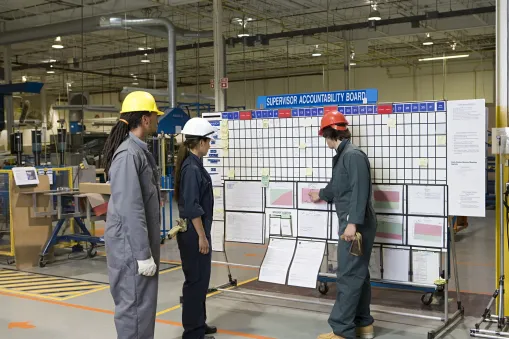
Visual management in high-mix environments means making the priority logic visible at the point where work decisions are made. That logic might consider customer commitment, constraint protection, material readiness, downstream capacity, aging WIP, and recovery requirements – not simply whichever order has the earliest due date. This does not require sophisticated technology – it requires a consistent system, maintained in real time, that reflects the actual production priorities and explains the logic behind them.
When operators understand not just what to do next but why, they are better positioned to adapt intelligently when conditions change.
The Lean Discipline That Scales With Complexity
Across high-mix environments I have worked in, the pattern is consistent: complexity is not a reason to abandon lean. It is a reason to design the flow system more deliberately.
In a repetitive, high-volume environment, abnormalities are often easier to detect because routing, sequence, takt, and standard work are more consistent. In a complex, variable environment, problems can remain hidden longer inside queues, changing priorities, shared resources, and routing complexity. The system therefore requires more deliberate flow governance – not less.
The organizations that succeed with lean in high-mix, low-volume environments are not the ones that apply repetitive-flow tools wholesale. They are the ones that understand the underlying disciplines – flow over local efficiency, WIP governance, and visual priority alignment – and adapt the specific mechanisms to their operating reality.
Diagnostic question for this week: Does your organization treat product complexity and mix variability as reasons lean cannot work – or as reasons that stronger flow discipline is essential? The answer to that question often determines whether complexity becomes manageable or overwhelming.
Want to talk about how lean manufacturing consulting could work in your plant?
FAQ
Yes. Lean is about making flow visible and controllable, not about standardization for its own sake. The tools differ from high-volume environments, but the underlying discipline (flow over local efficiency, WIP governance, visual priority alignment) applies more, not less, as complexity rises.
In many cases, tools designed for stable, repetitive flow were selected and applied in environments with complex routing, short runs, and high variability. When those tools produced disappointing results, the outcome was often interpreted as evidence that lean itself did not fit the environment. The issue was not necessarily the underlying lean discipline, but how the tools were chosen and applied.
The opposite, when WIP is ungoverned. Long queues raise the odds that something changes (a priority, a spec, a material situation) while work waits. Excessive WIP amplifies the effects of variability. Short, governed queues surface problems while they’re still manageable.
Making the priority logic visible where work decisions are made. An operator facing ten queued orders needs to know what to run next and why. Understanding the why is what lets teams adapt intelligently when conditions change.
It means measuring how smoothly work moves through the whole value stream instead of how busy any single machine is. Optimizing one work center in isolation often produces more output than the next operation can absorb, which builds WIP and slows the plant down even as utilization numbers look good.
Other posts in this series:
- Article 1: Operational Excellence Programs Are Not Enough. It’s Execution Physics That Determines EBITDA
- Article 2: Execution Physics: How Excessive Work In Process Quietly Destroys Margins
- Article 3: Operational Excellence Is a Leadership Behavior
- Article 4: Why Lean Transformations Plateau
- Article 5: Why Stability Drives EBITDA in Private Equity
- Article 6: The First 100 Days
- Article 7: Why Multi-Site Manufacturing Operations Lose Execution Control as They Scale
- Article 8: From Operational Due Diligence to Exit: Embedding Operational Excellence in the Value Creation Plan
- Article 9: Why Most Continuous Improvement Programs Miss the Private Equity Hold Period
- Article 10: Aerospace and Defense Operational Excellence: Compliance and Flow Are Not a Tradeoff
- Article 11: Lean in High-Mix, Low-Volume Manufacturing: What Actually Works < You’re here!
Latest Insights
-
Aerospace and Defense Operational Excellence: Compliance and Flow Are Not a Tradeoff
You can be fully compliant and still underperform operationally. This is not unusual, even in mature aerospace and defense organizations. The compliance infrastructure in…
-
A Plant Layout Redesign Without Losing a Shift
A Monday-morning lathe argument almost killed this aerospace plant layout redesign. One year later: 66% more parts shipped, 40% less cycle time.
Sign up to receive our latest insights!
"*" indicates required fields