
A Plant Layout Redesign Without Losing a Shift
Summarize this article with:
TL;DR
A major aerospace manufacturer was 300 parts behind on a critical engine program, with work-in-process pooled across the building and nearly half its in-house work outsourced to keep up. CBS ran a plant layout redesign, relocating 57 pieces of equipment (small mills through 5-axis CNC machines) around a live, unionized production schedule without stopping the line. One year later:
- Parts shipped per quarter up 66% (54 to 90)
- Cycle time down 40% (8.9 to 5.3 days)
- 42% of previously outsourced work brought back on site
- 57 pieces of equipment relocated (small mills through 5-axis CNC)
- Built-in quality checks raised first-time yield
The deciding factor wasn’t rigging precision. It was transparency with 20-year operators, starting with owning a first-weekend mistake.
Twenty people were standing around a lathe, yelling. It was a Monday morning in an aerospace plant, and a rigger crew had moved the machine into position over the weekend. Less than a foot off from where it needed to be. Close. But wrong. Wrong enough to break the flow we had designed. Wrong enough that a crew who had already watched one change initiative fizzle out was ready to quit on this one too.
That argument almost turned physical. It was the best thing that happened to the project.
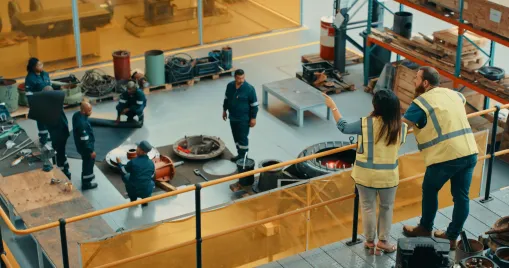
The client was a major aerospace manufacturer that builds parts for military vehicles and equipment. The engagement was a plant layout redesign inside a business unit that was behind by nearly 300 parts on a critical engine program. Work in process had pooled all over the building. Lead time was unmanageable. Nearly half of the work that should have been made in-house was being farmed out to outside providers just to keep up. We had two months, a unionized floor, and a business unit that could not stop producing while we moved 57 pieces of equipment.
This is the kind of assignment aerospace manufacturing consulting gets hired into when delivery is slipping and outsourcing is masking the problem.
What follows is what that engagement actually required. Not the sanitized version.
What a plant layout redesign really costs an aerospace operation
Before the 3P (Production, Preparation, Process) event, the routing of parts through this business unit wandered. Work bounced across a huge building, and in some cases left the building entirely to hit an outside supplier, then came back. WIP sat in pockets wherever space allowed. Nothing was deliberately placed. Over years, the shop had accumulated layout decisions no one had made on purpose.
That is the setup for every plant layout redesign I have walked into in aerospace and defense manufacturing. Nobody designed the mess. It compounded. Because the business unit had to hit delivery targets, leadership kept outsourcing work to cover the gap. That pulled margin down, pulled cycle time up, and quietly told every operator that their job might be next.
The 3P event, Production, Preparation and Process, exists to break that cycle. You map the process. You calculate capacity. You design the sequence that would actually serve the product, not the floor plan that evolved around it. And then you move the equipment that needs to move.
In our case, that meant 57 pieces of equipment, from small mills through 5-axis CNC machines. A complete redesign of the area. Approximately two and a half months to execute.
Why you cannot just stop the line for a plant layout redesign
The constraint that shaped everything: we could not stop production.
An aerospace business unit does not get to tell the supply chain it will be offline for sixty days to rearrange the floor. The engines still had to ship. That meant every move had to be sequenced against a live production schedule. The first piece to move could not be a piece the current process depended on that week. The last piece to move had to be timed so that the redesigned flow was ready to absorb it.
Layer on the union environment and the coordination problem multiplies. You cannot have the machinists move equipment. You cannot have the electricians move WIP. Riggers move machines. Machinists run them. Electricians run the drops. Plumbers run the lines. Different trades for different pieces of the same move. Each trade has its own lead time, its own scheduling, and its own rules about what can be touched.
A plant layout redesign in that environment is a sequencing problem wearing the costume of a facilities problem. The first weekend, we pulled an old mill, one that was hardly being used, as the opening move. Riggers disconnected it, lifted it, pulled it out of the building. Next in: a cleanup crew to wipe and prep the floor. Then electricians to set new drops for the piece coming in. Plumbers for the lines. Data techs for the switches. Then the next piece lowered in. Then repeat, 57 times.
When you describe this to people who have never run a live move, it sounds orderly. It is not. It is clunky for the first two or three moves. Then the rhythm arrives and the dominoes fall. But the rhythm only arrives if the team trusts that the plan is real.
The first weekend that reset the project
On the very first move, the riggers saw the space we had cleared and made a decision on their own. They were ahead of schedule. Space was empty. The next machine, a lathe, was sitting right there waiting. So they set it down.
Less than a foot off.
We had calculated where every workstation needed to be, down to the inch, so incoming and outgoing material would flow without a bottleneck. A foot is not nothing. A foot breaks the design. And on Monday, when the operators walked in, it was immediately obvious.
Twenty people. Yelling. A few crowding each other. The kind of argument where you can feel it tipping toward something worse.
I had to get in the middle and say, plainly: we made a mistake. The riggers were trying to get ahead of the game. Next time we communicate better. That is the only thing we can do.
That admission changed the project. In front of 20 angry operators, on the first weekend of a project that was already unpopular, we owned the mistake. From that point on, nothing moved until it had been checked and rechecked, two or three times, by everyone who had a stake in where it went. Not because a process document required it. Because the team had lived the consequence of skipping that step.
The rest of the 57 moves went into position on the first attempt.
What leaders miss about working with experienced operators
The hardest part of this engagement was not the equipment. It was the crew.
Some of these operators had been working in that business unit for over twenty years. They had watched consultants come in, do a project, leave, and have nothing sustain. They had been promised improvements that evaporated. By the time we arrived, they were not skeptical. They were exhausted by promises.
Here is what I have learned, and what I told them on day one: you cannot overstate the benefit. You lay it down as transparent as you can, because that is what buys you respect. People who have spent twenty years on a floor read through the lines. You really cannot fib your way around these guys.
So we said what we wanted to achieve. We said what we needed from them. We said what benefits looked possible, not guaranteed.
And then we did the thing that every plant leader claims to do and very few actually do: we took their input seriously. When operators proposed an adjustment, we ran it. When they flagged something the plan missed, we changed the plan. They were not consulted at the end. They were part of the process itself.
That is what converts a layout redesign from a project that gets tolerated into a project that gets protected.
What the numbers looked like one year later
Within two and a half months, the 57 pieces of equipment were in position. Standard work was in place. The shop had moved from pockets of WIP to something close to one-piece flow. We also built quality checks directly into the process itself. The earlier a defect gets caught, the cheaper it is to fix. That pulled first-time yield up across the line.
One year later, the measurable outcomes were:
- Parts shipped per quarter, up 66% (from 54 in Q3 to 90 in Q1 of the following year)
- Cycle time down 40% (from 8.9 days to 5.3 days)
- 42% of previously outsourced work brought back on site
- 57 pieces of equipment relocated to create continuous flow through the shop, from small mills to 5-axis CNC machines
- Built-in quality at the process level improved first-time yield
The operators noticed. Insourced work means job security. Job security in a business unit that had been hemorrhaging hours to outside vendors is not a soft metric. It is the thing that changes how the crew shows up on Monday.
Plant layout redesign: what leaders should do next
A plant layout redesign is a credibility project disguised as a facilities project. If you are planning one inside an aerospace, defense, or other regulated manufacturing environment (the kind of work aerospace manufacturing consulting firms often get pulled into when a business unit falls behind), three things matter more than the layout itself.
Sequence the moves against production, not against the calendar. The order in which equipment leaves and arrives is determined by what the line still has to ship this week, not by what is easiest for the rigger crew. Get the production plan and the move plan on the same sheet of paper before the first machine lifts.
Name the trades early. In a unionized environment, the coordination problem is never “move the machines.” It is sequencing the riggers, the electricians, the plumbers, the data techs, the cleanup crew, and the operators, each with their own scheduling rules, around a moving target. That coordination does not happen by accident.
Tell the operators the truth. Including when you make a mistake. Especially when you make a mistake. A team that has been through two decades of forgotten initiatives will not trust a plan they cannot see, and will not trust a leader who will not admit when the plan slipped. The admission is not weakness. It is what lets the next move go into position on the first try.
Common questions during plant layout redesigns
For a business unit with 50 to 60 pieces of equipment and a live production schedule, plan on roughly two to three months of execution after the 3P event itself. The engagement described above moved 57 machines in about 2.5 months.
Yes, but only if the move sequence is built against the current production schedule. The first machine to leave has to be one the line does not depend on this week; the last machine to arrive has to be ready to absorb the work flowing through the new layout.
Not the machines. The biggest risk is losing the trust of experienced operators on the first weekend. In a unionized shop, one misplaced piece of equipment is enough to convince a 20-year crew that the project is the same as the last one that failed. Communication discipline matters more than rigging precision.
3P stands for Production, Preparation, Process. It’s a structured event where a decision making, multi-disciplinary team maps the process, calculates required capacity, and designs the equipment sequence that best serves the product, rather than accepting the layout that evolved around the floor over time. In a plant layout redesign, the 3P event comes before any equipment moves. It is considered an advanced Lean tool and the expectation is that the facility has had an ongoing Lean program for a while.
Results depend on the operation, but in this aerospace business unit the redesign produced 66% more parts shipped per quarter, 40% lower cycle time, and 42% of previously outsourced work brought back in-house within a year, plus improved first-time yield from quality checks built into the process.
Closing thought
The outcomes from this engagement (66% more parts shipped, 40% less cycle time, 42% of outsourced work pulled back on site) read like a case study. Every one of them was the downstream effect of one uncomfortable conversation on one Monday morning, when a lathe was a foot off.
Plant layout redesigns do not fail because the math is hard. They fail because the communication is weak. Fix the communication, and the 57 machines move themselves.
Want to talk about your challenges? Let’s connect.
Latest Insights
-
Why Most Continuous Improvement Programs Miss the Private Equity Hold Period
Most continuous improvement programs were not designed for private equity timelines. Not because they are ineffective… they are just too slow! Traditional CI programs…
-
From Operational Due Diligence to Exit: Embedding Operational Excellence in the Value Creation Plan
See how operational due diligence signals translate into value creation plans and exit premiums across the PE lifecycle
Sign up to receive our latest insights!
"*" indicates required fields