The 300% Improvement That Started With a Bar and a Shelf
Summarize this article with:
TL;DR
This manufacturing process improvement case study covers a high-volume stamping cell that had an ergonomic problem baked into its design: an operator popping a part free by hand every 1.1 seconds, all shift. A five-person, client-based team attacked it iteratively. The fix was almost embarrassingly simple but the way we got there is the real lesson.
What changed:
- Cycle time: ~7.5 seconds per part down to 2–3 seconds (a 300% throughput improvement)
- Labor: a two-operator, full-day run became a one-operator, half-day run
- The fix: a bar and a shelf to knock parts free automatically, plus a scrap hopper and a few cell-layout moves
- Capital required: none
- What was recovered: hundreds of operator-hours per week, multiplied across a part that runs by the thousands
The constraint was never the machine. It was the manual process wrapped around it.
It was happening every 1.1 seconds.
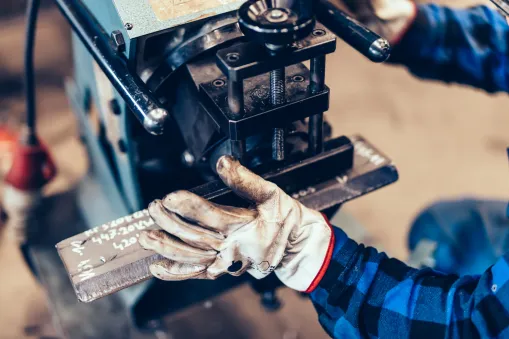
At a manufacturing operation that stamped parts from rolled material, the process had an ergonomic problem baked into its design. As each part was stamped out of the roll, it needed to be manually popped free by an operator and stacked. Every 1.1 seconds. Hour after hour. Day after day.
Once a small pile accumulated, the operator had to stop the machine, walk over, and shuffle the stack into alignment before transferring it to a box. The parts weren’t smooth (they had traction) so getting them to stack neatly took effort. Then back to the machine. Start it up. Repeat.
When you factored in all of the starts, stops, flipping, shuffling, and packing, the effective time per part came out to about seven and a half seconds. The cell was absorbing two operators for an entire day.
I was the single CBS resource on a five-person, client-based team that attacked this problem. What followed was an iterative, team-driven manufacturing process improvement engagement that reduced cycle time to between two and three seconds per part (a 300 percent improvement) and compressed that same two-person day into half a day for one person.
The solution involved a bar and a shelf.
But the way we got there is the more important story.
Where Manufacturing Process Improvement Should Start: the Volume
Before any improvement work begins, CBS asks a foundational question: where is the volume?
This principle is rooted in Theory of Constraints thinking. If you spend your energy improving a process that runs once every six months, the gains are minimal no matter how dramatic the percentage improvement looks. But if you attack the constraint that sits at the center of your highest-volume product (one that runs thousands of cycles every week) every second you shave multiplies accordingly.
Anytime we go in, the question is first of all, where’s your volume? And where there’s volume, little pieces help. If I can go into a product that I run 20,000 of a week and I can shave a second, I’ve saved you that number of hours every week.
This part was a high-volume runner. It ran constantly. Nobody had ever formally gone after the process. We identified it as the right place to start: because anything we found here would be multiplied by thousands, not tens.
The Problem: An Ergonomic Nightmare at 1.1 Seconds Per Cycle
The root of the issue was the machine’s exit mechanics. As parts were punched from a roll of material, the scrap edges continued forward while the parts themselves dropped out. But they didn’t drop cleanly; they needed to be held in place during the press cycle and then manually popped free.
The result was an operator stationed at the press for the duration of the run, manually flipping and popping out parts every 1.1 seconds: a highly repetitive motion with no break in the cycle. Between flips, the parts piled up in a disheveled stack that then had to be manually shuffled into alignment before packing.
While the operator was shuffling, packing, or loading new rolls of material, the machine was stopped. Green light time (the percentage of time the press was actually running and producing) was being consumed by all the manual intervention surrounding it.
The ergonomic burden was significant. The efficiency loss was significant. And because this was a constant, high-volume part, both problems were compounding every shift.
The Solution: Iterative Engineering, Not a Predetermined Answer
I didn’t arrive with a solution blueprint. I arrived with a framework, some relevant experience, and the discipline to work through the problem iteratively with the people who knew the process best.
It wasn’t my idea or his idea or her idea that really made it happen. It was our collective ideas working together.
The core insight was straightforward: if the parts could be knocked free automatically (without any manual intervention) the operator could be freed from the machine during the run. We engineered a bar positioned at the exit point of the press. As the material rolled through, the bar knocked the part out automatically, and the part dropped onto a shelf below.
But getting that right required iteration. The bar’s position mattered. Too high, too low, too close, too far: each configuration produced different results. We ran trial after trial, adjusting the setup, observing the outcome, and incorporating what we learned. Other fixtures were brought in. Guides were modified to be adjustable without tools. The shelf height was calibrated so that parts landed in a reasonably consistent stack.
There were many iterations. We tried to stack it like this, we tried farther out, we tried further in, it was just a matter of tinkering around with it until you figured it out. And everybody in the mix brought something to the table.
The final configuration eliminated the manual flip entirely. Parts now dropped onto the shelf while the machine continued running. The operator (no longer tethered to the press) could use green light machine time to prep stacks, stage boxes, and organize the next transfer. The only time the machine had to stop was to load a new roll of material or complete a pre-staged pack transfer.
The Rest of the Cell: Scrap and Flow
While we were solving the flipping problem, we also turned our attention to the rest of the work cell. Two additional improvements compounded the overall gain.
First, scrap management. The press generated edge scrap (the material surrounding each punched part) which had been falling directly onto the floor. Operators had to periodically stop what they were doing, collect the scrap from the floor, and carry it to a dumpster. We eliminated this by positioning a hopper at the end of the press discharge. Scrap fell directly into the hopper. When it was full, the operator emptied it. The floor stays clean, the handling is eliminated, and the interruption to productive work is removed.
Second, cell layout. A walkthrough of the cell revealed that the placement of equipment, materials, and workstations was creating unnecessary movement: operators crossing paths, reaching across to stations that should have been adjacent, traveling to areas that could have been consolidated. A few targeted moves (shifting where things lived in the cell) removed the wasted motion and reduced the physical fatigue that came with it.
Neither of these changes required capital investment. Both produced immediate, tangible improvement in the flow and ergonomics of the cell.
The Result of Our Manufacturing Process Improvement Engagement: 300% Improvement, Half the Labor
When the improvements were fully implemented and the process was measured, the numbers were clear.
The effective time per part dropped from approximately seven and a half seconds to between two and three seconds. That’s roughly a 70 percent reduction in cycle time: or, looked at the other way, a 300 percent improvement in throughput per unit of time.
The two-operator, full-day run became a one-operator, half-day run. The same volume of parts, produced with half the labor, in half the time.
One of the operators who worked in the cell, asked what she thought of the new process, offered her own estimate before the formal measurement came back: “It’s like 200% better.” She was close. It turned out to be 300%.
For a high-volume runner (a part produced by the thousands every week) that improvement compounds continuously. Every week, the operation is recovering hundreds of operator-hours that used to be consumed by manual intervention the machine could handle on its own.
Why the How Matters as Much as the What
The technical solution here (a bar, a shelf, a hopper, a few cell layout adjustments) is not particularly complex. What makes this case study worth examining is not the solution itself, but the process that produced it.
I describe the CBS approach to facilitated problem solving as one of deliberate restraint. Consultants arrive with relevant experience, pattern recognition, and an understanding of what best practices tend to look like. But arriving with a fully formed answer and handing it to the team is not how CBS operates, because it produces worse results.
My goal is always to have an idea of where we need to get to and let the team find their way there, knowing they are likely to come up with something even better. You plant little seeds along the way to lead people toward best practices, and let them have the ownership of coming up with a solution they believe in.
This isn’t manipulation. It’s change management grounded in how improvement actually sustains itself in manufacturing organizations. There are two reasons this approach outperforms the alternative.
The first is quality. When operators, engineers, and line personnel are genuinely involved in developing a solution, they bring knowledge that no outside consultant has: intimate familiarity with the machine, the quirks of the material, the ergonomics of the motion, the failure modes that have occurred before. In this engagement, operators knew which fixtures were available in the facility, how to adjust existing guides without special tools, and exactly what made the stacking difficult. That knowledge shaped the solution. A consultant arriving with a predetermined answer would have missed it.
The second is sustainability. If the people who use a process every day don’t understand it, didn’t help design it, and don’t have ownership over it, it degrades. Not out of malice, out of the natural drift that occurs when people follow instructions they don’t fully understand rather than operating a system they helped build.
If I didn’t have a piece of the development, I’m going to be much less likely to sustain it. Not just because it wasn’t my idea, it’s just that it doesn’t necessarily make sense to me.
The CBS approach (giving people a framework and letting the team build out the specifics) produces solutions that are better calibrated to the actual environment and more likely to hold over time.
The Constraint Wasn’t the Machine
One of the most important observations in this case study is what the constraint actually was.
Before we got involved, the operators and possibly the plant management believed that the press was running at or near capacity. Parts were being produced. The machine was in use. The operators were busy. What wasn’t visible was the amount of the machine’s potential that was being consumed by the manual work surrounding it: the flipping, the shuffling, the stopping and starting.
The constraint wasn’t the machine’s mechanical capacity. The constraint was the process wrapped around the machine. By redesigning that process, we unlocked throughput that had always been available but had never been accessible.
This is a recurring pattern in process improvement consulting work: the visible constraint is rarely the real one. The machine that seems maxed out often has 40 or 50 percent of its potential locked up in the work that happens before, during, and after the cycle, work that no one has ever formally examined because the machine has always run that way.
Asking the question (where’s the waste that surrounds the machine, not just in it) is one of the most productive things a process improvement consultant can do.
A Quick Quiz for You:
Start where the volume is. A second saved on a part you run 20,000 times a week returns hundreds of hours; the same gain on a low-volume part returns almost nothing. Identify the highest-volume cell first, then examine the manual work surrounding the machine, not just the machine itself.
In this case, it was the process wrapped around the machine. A press that looks maxed out often has 40–50% of its capacity locked up in flipping, shuffling, stopping, and starting, work no one has formally examined because the machine has always run that way.
What This Means for Manufacturers With High-Volume Operations
Most manufacturing operations have at least one of these scenarios: a high-volume part or process that has been running the same way for years, with waste baked into every cycle, that nobody has formally looked at because it’s “just how it’s done.”
The opportunity isn’t always obvious. The ergonomic nightmare may be so embedded in the routine that it no longer registers as a problem: it’s just the job. The machine may appear to be running at capacity because it’s always in use, even when the real production rate is being suppressed by manual intervention.
Manufacturing process improvement consulting at CBS starts by asking where the volume is: and then examining what’s actually happening in those cells, in detail, with the people who work them. The improvements that result aren’t always dramatic in concept. A bar. A shelf. A hopper. A few layout changes. But at the right volume, in the right cell, those improvements can cut a two-person day to half a day, and free hundreds of operator-hours per week for productive work.
This is a recurring pattern across 25+ years and hundreds of millions of dollars in client savings: the visible constraint is rarely the real one.
If your highest-volume operations have processes that have never been formally examined, CBS can help you see what’s there. Contact us to start the conversation.
Latest Insights
-
Operational Excellence Through Facility Layout Optimization
Most throughput problems are really flow problems; and flow is a function of layout. This piece lays out the hands-on method CBS uses to…
-
Why Lean Transformations Plateau
Early lean gains are real, and so is the plateau that follows. Tim Christlieb explains why the constraint shifts from individual processes to the…
Sign up to receive our latest insights!
"*" indicates required fields